-2.jpg)
今回はフットプリントの指標として用いられる「Arch Index」について解説していきます。
Arch Indexはフットケアに従事している方なら、一度は聞いたことがあるのではないでしょうか。
そのArch Indexの論文と指標としての信頼性、また、他の項目との相関について解説していきます。
論文
PETER R. CAVANAGH ,MARY M. RODGERS.
「THE ARCH INDEX: A USEFUL MEASURE FROM FOOTPRINTS.」
J. Biomechanics Vol. 20, No. 5, pp. 547-551, 1987
doi: 10.1016/0021-9290(87)90255-7.
PMID: 3611129
目的
Although different foot types are well recognized as separate clinical entities (pes planus, pes cavus, etc.) there is, at present, no simple quantitative definition that would serve to classify feet on the basis of the MLA.(PETER R. CAVANAGH ,MARY M. RODGERS.THE ARCH INDEX: A USEFUL MEASURE FROM FOOTPRINTS.J. Biomechanics Vol. 20, No. 5, pp. 547-551, 1987より引用)
異なる足型(扁平足、高アーチ足など)は、それぞれ独立した臨床的実体として広く認識されているものの、現時点では、MLAに基づいて足を分類するための単純な定量的定義は存在しない。
introductionでは、Irwin(1937)が提唱したfootprint index、Jung(1982)がBrucken index、Schwartzらは足跡角(footprint angle)を導入したと述べられていますが、評価上の問題や手間がかかることを指摘しています。
方法
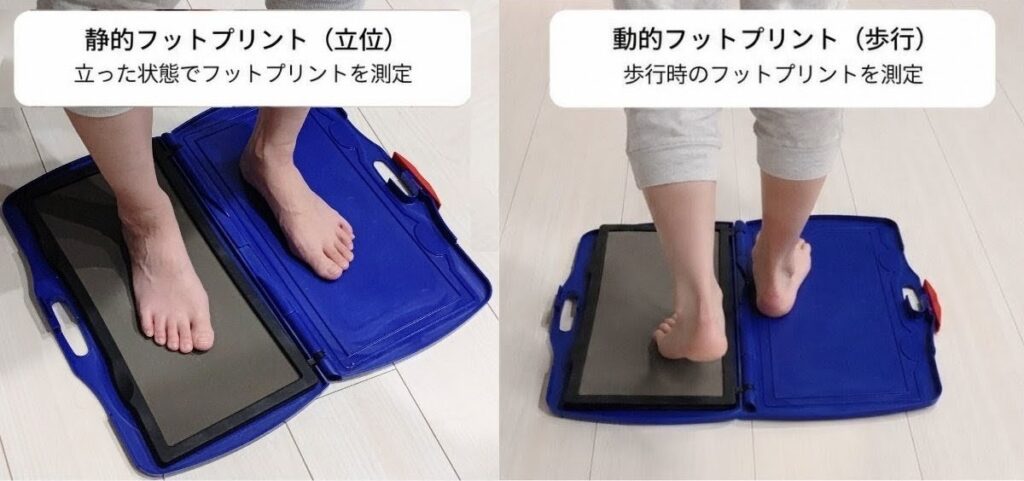
本論文では、フットプリントを静的と動的で採取する方法を提案しています。
静的フットプリント:
1.片足を体重計に載せ、反対側にインクを塗る。
2.徐々に体重の半分が体重計に表示されるまで、インクを塗った足に徐々に体重を移してく(Overshoot(行き過ぎ):体重を乗せ過ぎないように注意する)。
動的フットプリント:
1.動的足跡については、被験者は床にテープで固定された紙の1歩後ろに立つ。
2.足にインクを塗り、被験者は通常の歩行の開始時と同様に、紙の上へ一歩踏み出し、再び足を離す。
Arch Indexの算出方法は、以下の通りです。
Marking of the footprint starts with a line which is drawn from the center of the heel (point k ) to the tip of the second toe. This line is termed the ‘foot axis’. A second line perpendicular to the axis is then drawn such that it is tangential to the most anterior part of the outline of the main body of the footprint in front of the metatarsal heads. The point of intersection between these two lines is marked (point j ). The line jk is then divided into three equal thirds, as shown in Fig. 2b. A perpendicular line to the foot axis is drawn at each 33.3% mark along jk dividing the foot into rearfoot (A), midfoot (B) and forefoot (C) regions.(PETER R. CAVANAGH ,MARY M. RODGERS.THE ARCH INDEX: A USEFUL MEASURE FROM FOOTPRINTS.J. Biomechanics Vol. 20, No. 5, pp. 547-551, 1987より引用)
1.かかとの中心(点k)から第2趾の先端へと引く。この線は「足軸(’foot axis)」と呼ばれる。
2.この軸に垂直で、中足骨頭の前の足跡本体輪郭の最前端に接するように、2本目の線を引く。
3.これら2本の線の交点をマークする(点j)。
4.線jkを3等分する。
5.線jk上の各33.3%の位置に足軸に垂直な線を引いて、足を後足部(A)、中足部(B)、前足部(C)の領域に分割する。
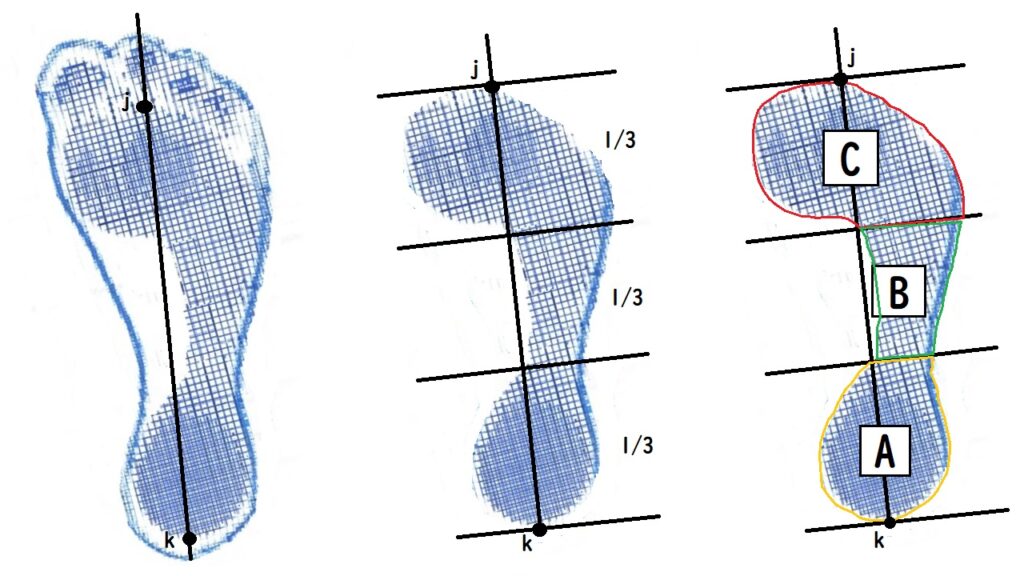
分割した領域を、以下の計算式を使うことでArch Indexを算出します。
Arch Index= A+B+C/B
結果
The arch indices for one foot from each of 107 subjects were measured from half body weight static footprints. These individuals, who all reported themselves free of foot pain, were subjects in a related study of pressure distribution in standing. The subjects were a heterogeneous group of 41 females and 66 males with a mean age of 30.1 yr (S.D. 9.85), height 1.74 m (S.D. 0.11 m), weight 701 N (S.D. 146), and foot length 0.258 m (S.D. 0.0019 m). The distribution of arch indices in this group is shown in Fig. 4. The mean and median value was 0.230 and the standard deviation was 0.0463.(PETER R. CAVANAGH ,MARY M. RODGERS.THE ARCH INDEX: A USEFUL MEASURE FROM FOOTPRINTS.J. Biomechanics Vol. 20, No. 5, pp. 547-551, 1987より引用)
107名の被験者それぞれの片足について、体重の50%をかけた静止時の足跡からアーチ・インデックスを測定した。これらの個人は全員、足の痛みがないと自己申告しており、立位時の圧力分布に関する関連研究の被験者であった。
対象者の情報↓
対象者:女性41名、男性66名
平均年齢:30.1歳(SD 9.85)
身長:1.74m(SD 0.11m)
体重:701N(SD 146)
足長:0.258m(SD 0.0019m)
平均値および中央値:0.230
標準偏差:0.0463
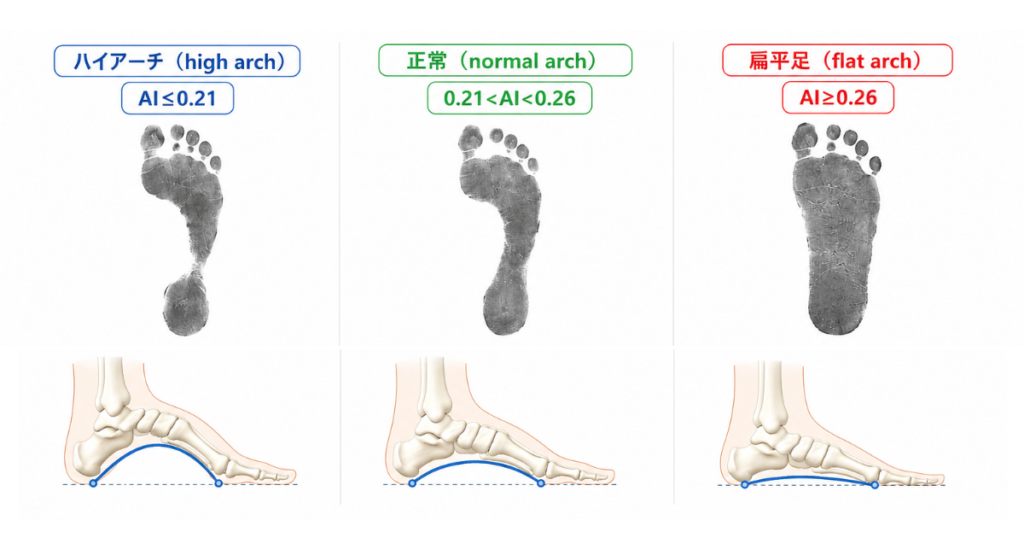
これらの結果から、著者らは以下の区分でHigh arch、Normal arch、Flat archに分類することを推奨しています。
・ハイアーチ(high arch):AI≤0.21
・正常(normal arch)  :0.21<AI<0.26
・扁平足(flat arch)  :AI≥0.26
関連論文
ここからは、Arch Indexの信頼性や他の指標との相関について、インソールに関する関連論文を紹介します。
信頼性に関して
↓検者内信頼性について
Six studies investigated the reliability of AI. A high intra-rater reliability (ICC = 0.96–0.99) was demonstrated across three studies.(Arnold Hu, John B. Arnold, Ryan Causby et al. The identification and reliability of static and dynamic barefoot impression measurements: A systematic review.Forensic Science International,289, 156–164より引用)
6つの研究でAIの信頼性が検証された。3つの研究において、高い同一評価者間(検者内)信頼性(ICC = 0.96~0.99)が確認された。
↓検者間信頼性に関して
In this assessment of reliability, all indices of footprint, excluding the arch angle, have an ICC value greater than .80, which would indicate excellent interrater reliability.(M. Owen Papuga et al.THE RELIABILITY OF THE ASSOCIATE PLATINUM DIGITAL FOOT SCANNER IN MEASURING PREVIOUSLY DEVELOPED FOOTPRINT CHARACTERISTICS: A TECHNICAL NOTE.Journal of Manipulative and Physiological Therapeutics ,Volume 34, Number 2, pp. 114-118, 2011)
この信頼性評価において、Arch Angleを除くすべての指標のICC値は0.80を超えており、これは評価者間信頼性が極めて高いことを示している。
検者内信頼性はICC = 0.96~0.99、検者間信頼性は0.8以上であり、両者ともに高い信頼性が報告されています。
Arch Angleとの相関
フットプリントの指標として、Arch Angleがあります。
Arch AngleはClarke(1933)によって定義されたもので、足型の内側の境界線と、中足部の最も内側の点と縦アーチが最初に接する点を結ぶ線との間の角度と定義されています。
Michael ら(1992)は、Arch Indexとの相関係数は「-0.81」と報告しており、両者の間に非常に強い負の相関があることを示しています。つまり、Arch Angleが大きくなるほど、Arch Indexが小さくなるという関係性にあります。
靴との関係性
It is well-known that filling the void space between the foot-arch and shoe reduces the plantar pressure, alleviates impact force, and improves shoe comfort .(Sungkuk Chun, Sejin Kong et al. A Foot-Arch Parameter Measurement System Using a RGB-D Camera.Sensors 2017, 17-8, 1796より引用)
足のアーチと靴の間の隙間を埋めることで、足底圧が低下し、衝撃力が緩和され、靴の履き心地が向上することが知られている。
Arch Indexとインソールや靴との関連性を直接的に述べている論文は見当たりません。
しかし、Arch Indexなどの指標を使用することでアーチの状態を確認し、インソールで調整することで靴のフィット感を高められる可能性があります。
評価指標としてのメリット・デメリット
数値としてアーチの状態がわかる
フットプリントは、見た目で判断することが多いと思われますが、フットケアに従事するベテランのスタッフでも、
など悩むことも多いと思います。
特にフットプリントをあまり見たことがないスタッフは、判断を誤りがちです。
数値を算出することで、スタッフ間の共有もしやすくなり、インソール作成もより制度が高くなると思われます。
算出に時間がかかる
デジタル式のフットプリントであれば、ものの数秒で結果がでます。
しかし、インク式でArch Indexを算出する場合は、
➀フットプリントを採取する
➁フットプリントをPCへ取り込む
➂ImageJなどの解析ソフトで面積(前足部/中足部/後足部)を計測する
➃Arch Index= A+B+C/Bで計算して算出
上記の工程が必要になります。
現状では、数値としてArch Indexを算出し、その場で患者やお客様へ説明するのは困難ですね。。。
ゴースト現象に注意
For example, finding a light, shadow-appearing marking around the rear of the heel and/or at the tips of one or more toes of the footprint are termed “ghosting,” and research suggests their presence means a footprint is dynamic. Contrarily, the absence of ghosting does not necessarily mean a footprint is static, as research on this issue is lacking.(Richa Mukhra, Kewal Krishan dt al. Comparative analysis of static and dynamic bare footprint dimensions in a north Indian population.Forensic Science International,Volume 308,p1-9.より引用)
「例えば、足跡の踵(かかと)の後方や、1つまたは複数の足指の先端付近に見られる、影のように現れる薄い印は**『
ゴースト現象(ghosting)』**と呼ばれており、研究によれば、その存在は足跡が動的(歩行中など)であることを示唆している。逆に、ゴースト現象が見られないからといって、必ずしもその足跡が静的(静止状態)であることを意味するわけではない。」
ゴースト現象は動的(歩行中)によくみられる現象のようです。
ICt~のheel contactやTSt~における蹴り出し時に生じる「ズレ」により、ゴースト現象が生じると思われます。
特に、インク式では一度接地すると痕がついてしまうため、注意が必要です。
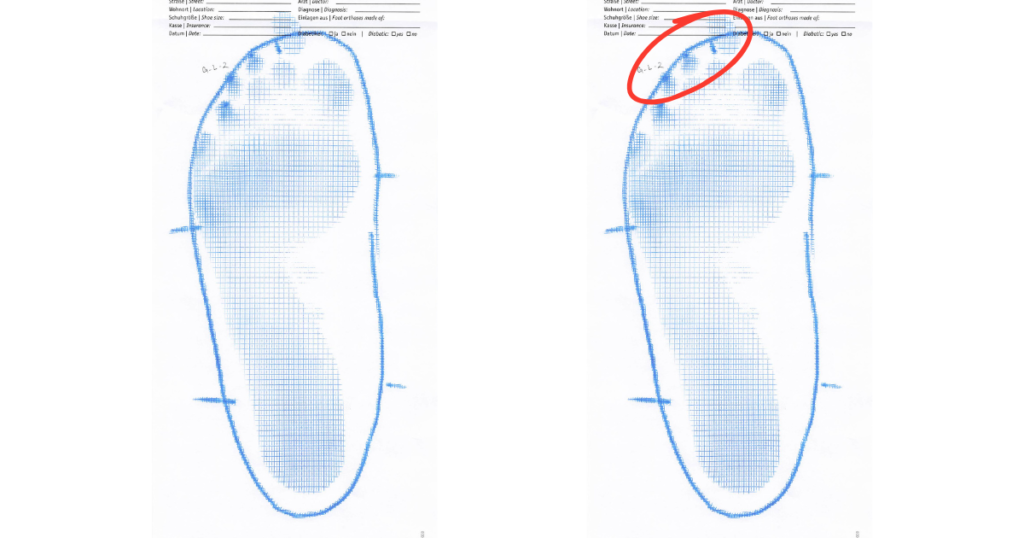
↑ゴースト現象(ghosting)
動的フットプリントでは、解釈に注意しましょう。
まとめ
ここまで、Arch Indexについて解説してきました。
内側縦アーチの低下の指標として数値で判定されるため理解しやすい一方、インク式では解析までに時間がかかるなどのデメリットもあります。
他の指標と組み合わせて、足部評価の一助となるといいと思います。
最後までご覧いただき、ありがとうございました。


コメント